
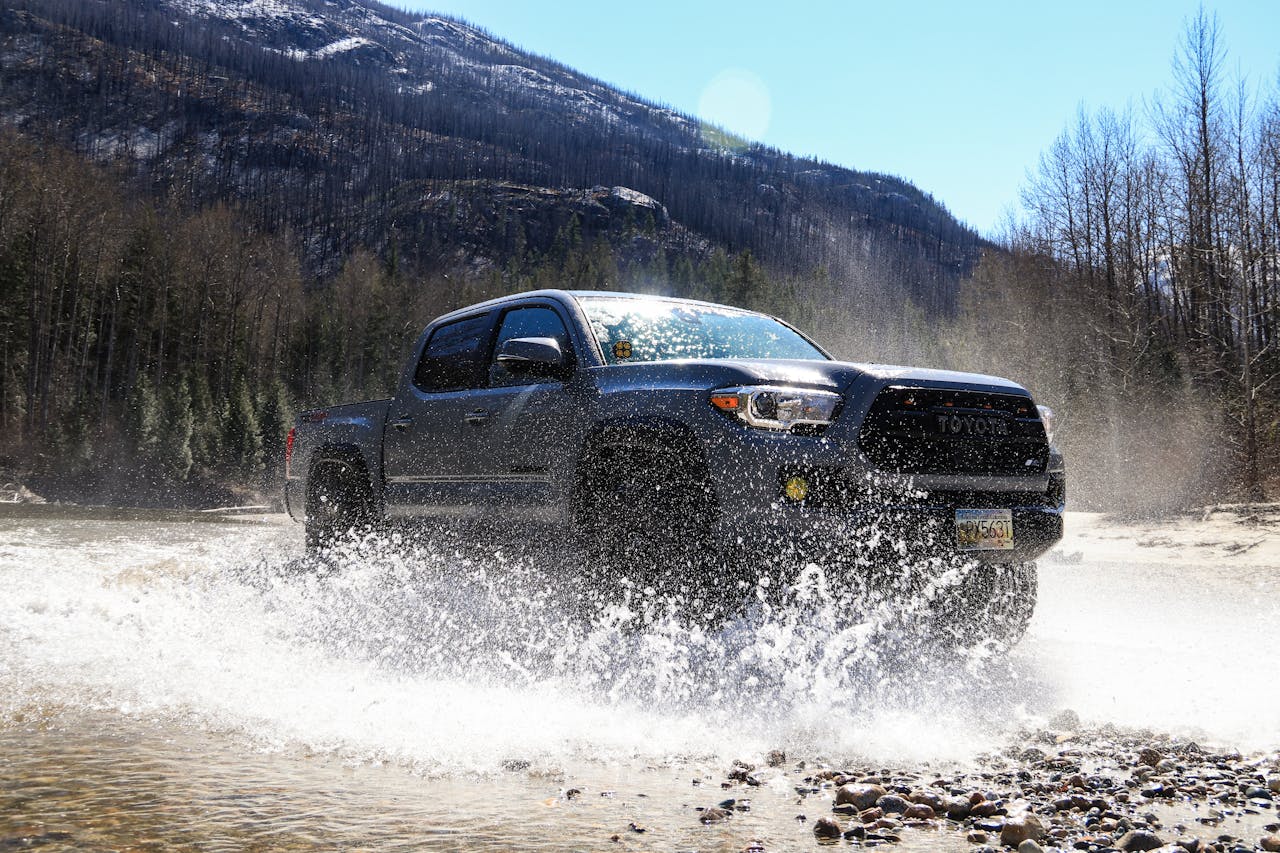
The Complete 3rd Gen Tacoma Lift Kit Guide (2016–2023)
The most complete 3rd Gen Tacoma lift guide available. Real-world owner data, 2” vs 3” lifts, alignment specs, CV angles, tire fitment, needle bearing issues, and long-term reliability.
Check your exact setup before you buy parts
Use the Tacoma Tire Fitment Calculator to estimate rubbing risk by tire size, wheel offset, and lift height.
On this page
Why Lift a 3rd Gen Tacoma?
If you own a 3rd Gen Toyota Tacoma (2016–2023), installing a lift kit is one of the most common and most debated modifications. The platform responds well to suspension upgrades, and the aftermarket support is enormous. From entry-level spacer lifts to premium coilover systems, there are countless ways to change the stance and capability of the truck.
However, after reviewing hundreds of owner reports, forum discussions, long-term durability updates, and real-world build data, one pattern consistently appears:
Most owners lift higher than they actually need.
The visual appeal of a taller Tacoma is undeniable. Social media is filled with aggressively built trucks running 3-inch lifts and 33–35” tires. But when you separate aesthetics from mechanical reality, the optimal lift height for daily driving, long-term reliability, and balanced performance is often lower than expected.
This guide focuses on what actually works in the real world — not what photographs best on Instagram. We’ll break down suspension geometry, CV angles, alignment considerations, ride quality changes, and long-term wear so you can make a decision based on performance, not hype.
Why Do Owners Lift a 3rd Gen Tacoma?
Most Tacoma owners lift their trucks for a combination of practical and aesthetic reasons. The most common motivations include:
- Clearing larger tires, especially the popular 33-inch setup
- Increasing ground clearance for trail use
- Improving approach and breakover angles
- Enhancing stance and visual presence
- Replacing factory soft suspension with firmer, more controlled components
From a capability standpoint, lifting a Tacoma can absolutely improve off-road performance when paired with the correct tire size and suspension components. It can also significantly improve ride control if the factory suspension feels underdamped or overly soft.
But here’s the key factor many overlook:
How high you lift matters more than most people realize.
Even small increases in ride height affect suspension geometry, CV axle angles, caster alignment range, and long-term component wear. The difference between a 2-inch lift and a true 3-inch lift is not just one inch of height — it’s a meaningful shift in mechanical stress and setup complexity.
Understanding that difference is what separates a balanced build from a problem build.
Larger tire clearance (33” goal)
Improved ground clearance
Better stance
Off-road capability
Replacing factory soft suspension
2-Inch vs 3-Inch Lift: Real-World Differences
When it comes to lifting a 3rd Gen Tacoma (2016–2023), the most common debate is simple:
Should you go with a 2-inch lift or a full 3-inch lift?
On paper, the difference sounds minor — just one inch. In reality, that one inch significantly changes suspension geometry, CV axle angles, alignment range, ride quality, and long-term component wear.
A 2–2.5” lift generally keeps the Tacoma within factory-friendly geometry. A true 3” lift pushes the front suspension much closer to its mechanical limits. That doesn’t mean 3 inches is “bad,” but it does mean the margin for error becomes smaller, and supporting modifications often become necessary.
Understanding this difference is critical if your Tacoma is a daily driver.
2–2.5” Lift (The Sweet Spot)
For most 3rd Gen Tacoma owners, a 2 to 2.5-inch front lift is the optimal balance between capability, reliability, and ride quality. This range allows meaningful tire clearance and improved stance without dramatically increasing stress on key suspension components.
At this height, the Tacoma maintains relatively favorable CV axle angles, ball joint geometry, and caster alignment range. Most trucks can still be aligned within factory specifications without requiring aftermarket upper control arms (UCAs), although they may help fine-tune performance.
Best For:
- Daily drivers that see highway use
- Weekend trail and light off-road use
- Owners prioritizing long-term reliability
- 32” to 33” tire setups (with proper wheel offset)
A properly set up 2–2.5” lift often clears 285/70R17 (33”) tires with minimal trimming when paired with appropriate wheel offset. Ride quality typically improves over factory suspension when quality shocks or coilovers are used, especially compared to the stock “soft and floaty” feel many Tacoma owners report.
From a long-term durability standpoint, this lift height reduces the likelihood of:
- Premature CV axle wear
- Excessive ball joint stress
- Alignment sensitivity
- Needle bearing vibration issues
In real-world owner data, this range consistently shows the best balance of performance, comfort, and mechanical longevity.
Why 2–2.5” Is Considered the “Sweet Spot”
The 3rd Gen Tacoma’s front suspension design simply responds better to moderate lift heights. The truck was not engineered around extreme droop angles, and pushing beyond 2.5 inches increases the front CV angle noticeably.
While a 3-inch lift is commonly marketed as “standard,” the data from long-term owners suggests that most people who primarily daily drive their Tacoma are happiest in the 2–2.5 inch range. It provides:
- Noticeably improved stance
- Practical tire clearance
- Better trail capability
- Minimal compromise to drivability
It’s enough lift to transform the truck — without fundamentally altering how it behaves on the road.
- Maintains better CV angles
- Less stress on ball joints and tie rods
- Easier alignment
- Often no need for aftermarket UCAs
- Often no need for aftermarket UCAs
- Better ride comfort
- —
Why 2–2.5” Is the Best Long-Term Balance
After reviewing long-term owner reports, forum data, and real-world build outcomes, one conclusion consistently emerges:
A 2–2.5 inch lift offers the best overall balance of performance, longevity, and cost on a 3rd Gen Tacoma (2016–2023).
At this height, the truck gains meaningful tire clearance and improved stance without dramatically increasing front CV axle angles or pushing suspension components beyond their ideal operating range.
The Three Areas That Matter Most
Performance:
A moderate lift improves approach angle, trail capability, and tire clearance while maintaining predictable steering and highway stability. The truck still feels like a daily driver — not a compromised off-road build.
Longevity:
CV axles, ball joints, tie rods, and wheel bearings operate closer to factory geometry. Long-term wear rates remain more consistent compared to higher lift setups.
Cost:
You typically avoid mandatory supporting upgrades like aftermarket UCAs, differential drops, and additional alignment correction components.
For the majority of owners who daily drive their Tacoma and hit trails occasionally, this height simply makes the most practical sense.
3” Lift (Maximum Common Height)
A true 3-inch lift is widely considered the upper practical limit before suspension geometry changes become significant on a 3rd Gen Tacoma.
That doesn’t mean it’s a bad option — but it does mean you’re now operating closer to the edge of factory design tolerances.
Best For:
- 33” tires with minimal trimming
- Aggressive visual builds
- Dedicated off-road use
- Owners planning additional supporting modifications
At 3 inches of front lift, CV angles noticeably increase. Alignment becomes more sensitive. Caster correction can become difficult without aftermarket upper control arms. The truck will often look better — but it may require more supporting components to maintain proper drivability.
For many owners, 3 inches is where “simple lift” turns into a more complete suspension build.
The Hidden Issue: Tacoma Needle Bearing Vibration
One of the most discussed real-world issues after lifting a 3rd Gen Tacoma is vibration between 35–55 mph, especially under light throttle.
This problem has become so common that it has a name in Tacoma communities.
What Causes It?
The factory front differential uses a needle bearing on the driver-side CV axle. When lift height increases, the change in axle angle can load this bearing differently than intended. Under certain conditions, this leads to vibration that feels like an out-of-balance tire.
This issue becomes more common as lift height increases — particularly above 2.5 inches.
Common Fix
The most widely recommended solution is replacing the factory needle bearing with a solid bushing, such as the one offered by East Coast Gear Supply (ECGS).
The ECGS bushing conversion eliminates the needle bearing and replaces it with a solid support that better tolerates increased CV angles.
It’s not required on every truck — but it is frequently reported on 3-inch lift setups.
Do You Need a Diff Drop?
The “diff drop debate” is a constant topic in Tacoma forums and Reddit threads.
General Consensus:
- 2–2.5” lift → Not necessary
- 3” lift → Debatable
A differential drop kit lowers the front differential slightly to reduce CV axle angle. While it does decrease angle marginally, it does not return geometry to factory levels.
Most experienced builders agree that a diff drop is not a magic solution. It may slightly reduce stress, but it does not eliminate the increased load introduced by higher lift heights.
For most moderate builds, investing in quality suspension components yields more benefit than adding a diff drop.
Upper Control Arms (UCA): When Are They Required?
Upper control arms become relevant as lift height approaches or exceeds 2.5 inches.
The primary issue isn’t strength — it’s alignment geometry.
As front ride height increases, caster decreases. Proper caster is critical for:
- Highway stability
- Steering return-to-center
- Reduced wandering
Target Alignment for 3rd Gen Tacoma:
3–4 degrees positive caster
If your alignment shop cannot achieve that range after lifting, aftermarket UCAs are typically the solution. They provide additional adjustment range and often improve suspension articulation as well.
In many 2-inch lift setups, factory UCAs can still work. At 3 inches, aftermarket UCAs are strongly recommended.
What Tire Sizes Actually Fit?
| Setup | Tire | Offset | Notes |
|---|---|---|---|
| Stock Suspension: | 265/70R16 (31.6”) | — | — |
| Largest Safe on Stock: | 275/70R17 (~32.2”) | — | May require minor trimming. |
| With 2–2.5” Lift: | 285/70R17 (33”) | — | Possible trimming required. |
| With 3” Lift: | 285/70R17 common | — | Cab mount chop (CMC) may be required depending on offset. |
| Alternative Skinny Option: | 255/85R16 | — | Often clears easier than 285s. |
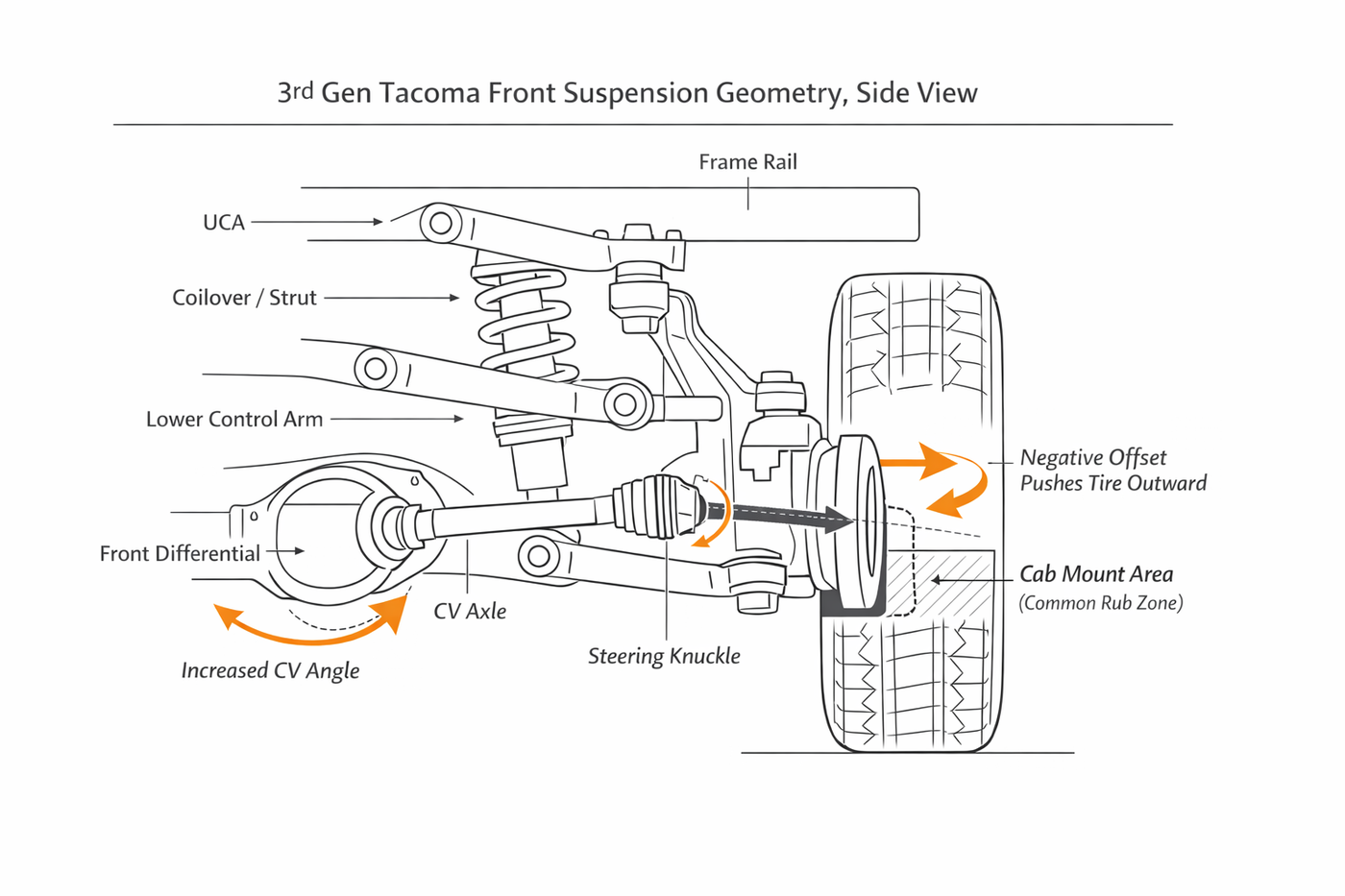
Wheel Offset Matters More Than Tire Size
One of the most common mistakes 3rd Gen Tacoma owners make isn’t choosing the wrong tire size — it’s choosing the wrong wheel offset.
Many aggressive builds run large negative offset wheels because they look good in photos. But pushing the wheel outward dramatically changes suspension geometry and scrub radius.
Recommended Offset Range for 3rd Gen Tacoma:
0mm to +15mm
This range keeps the wheel closer to factory geometry while still allowing a wider stance.
When you move into negative offset territory (–12mm, –25mm, etc.), you increase:
- Fender rubbing during turning and compression
- Required trimming and body mount chop likelihood
- Stress on wheel bearings and ball joints
- Steering kickback and long-term wear
In real-world owner reports, excessive negative offset often causes more rubbing issues than tire diameter alone. A properly chosen 285/70R17 tire with moderate offset typically fits better than a smaller tire on a highly aggressive wheel.
For most daily-driven Tacomas, staying within 0mm to +15mm provides the best balance of clearance, drivability, and reliability.
Shock & Lift Options (Most Recommended Setups)
Lift height is only half the equation. The quality of the suspension system determines ride comfort, control, and long-term durability.
Based on long-term owner satisfaction and repeated forum recommendations, these setups consistently rank highest:
Budget-Friendly Option:
Bilstein 5100
The Bilstein 5100 is arguably the most popular entry-level upgrade for the 3rd Gen Tacoma. It offers improved damping over factory suspension and adjustable front height settings.
Best for:
- Mild 2” lift setups
- Daily drivers
- Budget-conscious builds
While not a true coilover system, the 5100 significantly improves body control compared to factory shocks.
Mid-Tier (Extremely Popular):
Bilstein 6112 Front + 5160 Rear
This combination is widely regarded as the “sweet spot” suspension upgrade.
The 6112 front uses a larger shock body for improved heat dissipation and damping control, while the 5160 rear includes a remote reservoir for better performance under repeated compression (trail use).
Best for:
- 2–3” lift setups
- Mixed daily driving and off-road use
- Owners wanting improved ride quality without going full coilover
This setup offers a noticeable upgrade in comfort and control over spacer lifts or entry-level shocks.
Other Highly Rated Systems:
- Dobinsons IMS
- Old Man Emu (OME)
- Select premium coilovers (Fox, King, Icon)
These systems typically provide better tuning options and durability but come at higher cost.
Spacer Lifts: The Trade-Off
Spacer lifts are inexpensive and simple, typically ranging from $300–$600. However, they do not improve damping. They simply preload or space out factory suspension components.
Common drawbacks include:
- Harsher ride
- Reduced down-travel
- No improvement in shock performance
For owners focused on long-term satisfaction, true suspension upgrades outperform spacer lifts in nearly every category.
Ride Quality Reality Check
The factory 3rd Gen Tacoma suspension is widely described as soft and under-damped. Body roll and nose dive are common complaints.
Upgrading to quality shocks or coilovers often improves ride quality — even when adding lift.
However, tire choice dramatically affects ride comfort.
Tire Load Rating Matters
Many owners install E-load (10-ply rated) tires for durability. While strong, these tires significantly stiffen the ride — especially for daily drivers.
For mixed-use or primarily street-driven Tacomas, experienced owners often recommend:
- C-load tires
- SL-rated (Standard Load) tires
These provide adequate strength while maintaining better ride compliance.
In many cases, tire choice affects ride comfort more than lift height.
Long-Term Reliability Data
When installed correctly, moderate lift setups on a 3rd Gen Tacoma are very reliable.
Owners running:
- 2–2.5” lift
- Proper alignment (3–4° positive caster)
- Quality suspension components
Frequently report minimal issues beyond 100,000+ miles.
However, as lift height increases, so does component stress.
Common Issues at 3”+:
- Accelerated ball joint wear
- CV boot cracking or tearing
- Increased alignment sensitivity
- Needle bearing vibration
This doesn’t mean a 3-inch lift is unreliable — but it does require more attention to supporting components and maintenance.
Cost Breakdown (Realistic Expectations)
Understanding the full cost of a lift helps avoid budget surprises.
Spacer Lift:
$300–$600
(Lowest cost, minimal performance improvement)
Bilstein 5100 Setup:
$800–$1,200
(Strong value option)
6112 / 5160 or Similar Mid-Tier:
$1,200–$2,000
(Best balance of performance and durability)
Premium Coilovers:
$2,000–$3,500+
(Advanced tuning, best off-road performance)
Additional Costs:
- Alignment: $100–$150
- Installation: $300–$800 depending on region
- UCAs (if needed): $400–$900
- Needle bearing fix (if needed): ~$150–$200
A realistic total budget for a quality 2–3” suspension lift often lands between $1,500–$2,500 installed.
Final Recommendation (Based on Owner Data)
For roughly 80% of 3rd Gen Tacoma owners, the most balanced setup is:
- 2–2.5” quality suspension lift
- 285/70R17 (33”) tires
- 0mm to +15mm wheel offset
- Proper alignment (3–4° positive caster)
This configuration consistently delivers:
- Reliable suspension geometry
- Strong ride quality improvement
- 33” tire clearance with manageable trimming
- Minimal long-term wear
Going to a full 3-inch lift is absolutely viable — but it requires more supporting modifications, more attention to alignment, and greater awareness of potential vibration or wear issues.
For most daily-driven Tacomas, moderation wins.
Next Step
Before purchasing parts, review:
- What Size Tires Fit a 3rd Gen Tacoma Without Rubbing?
- 2” vs 3” Lift: Which Should You Choose?
Choosing components in the right order prevents wasted money and unnecessary rework.
Related products
Product recommendations will appear here when the Auto Fit Essentials Shopify store is connected with real inventory. We do not show placeholder products.
Found this helpful?
Share it with fellow Toyota enthusiasts!
Get the Tacoma checklist
Free 3rd Gen Tacoma Maintenance and Upgrade Checklist — practical sequencing tips, no spam.
Keep learning
Explore more guides, maintenance checklists, and fitment tips for your Toyota.
More Toyota Guides
Continue learning with our expert articles