
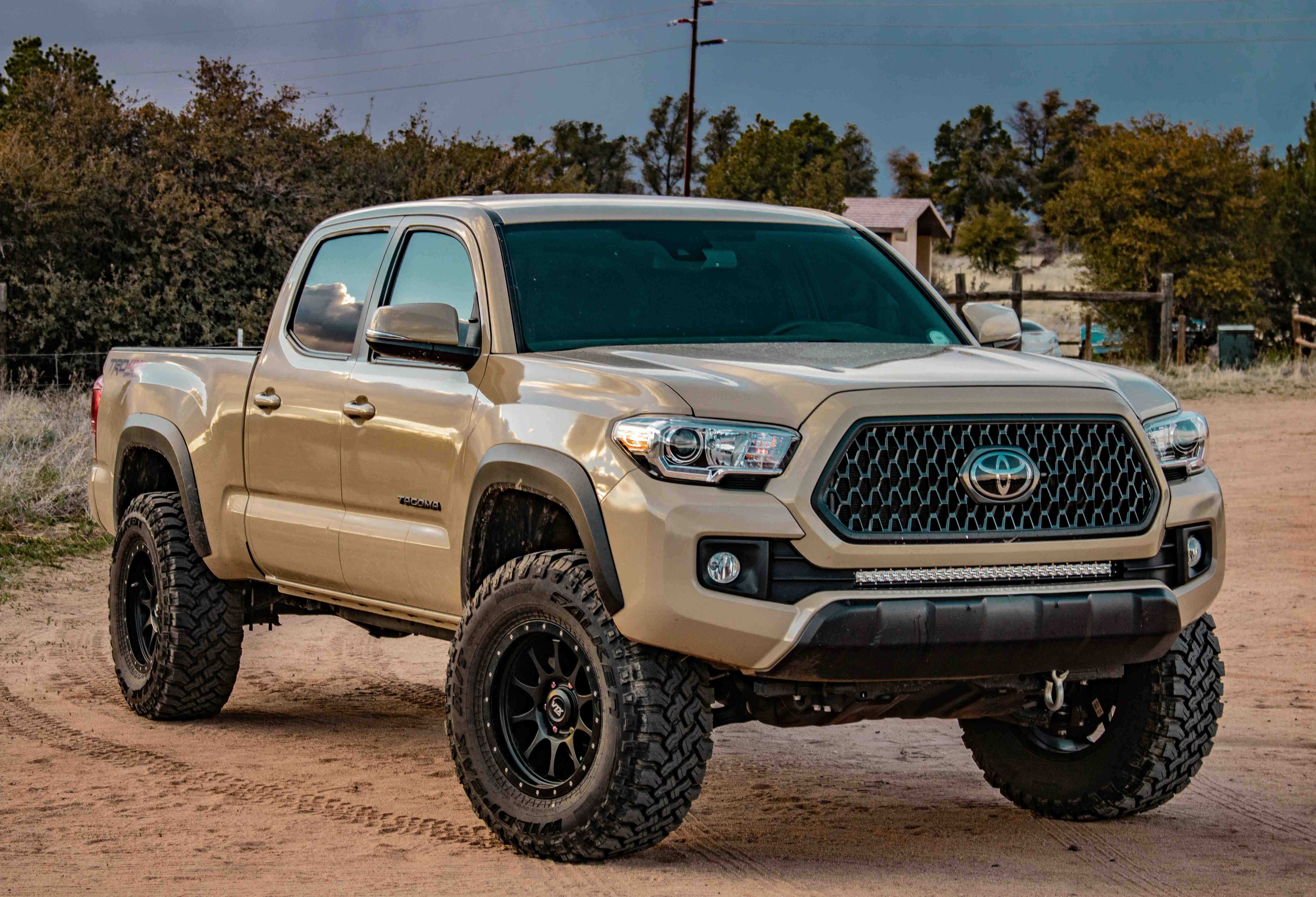
Tacoma Tire Fitment Guide: What Clears, What Rubs, and What to Check First
Applies to: Toyota Tacoma · 3rd Gen · 2016–2023
Figuring out what tire sizes actually clear on a 3rd Gen Tacoma (2016-2023) comes down to more than diameter. This guide breaks down the interplay between tire size, wheel offset, lift height, and trimming so you know what fits, what rubs, and what to check before you buy.
Difficulty: intermediate
Check your exact setup before you buy parts
Use the Tacoma Tire Fitment Calculator to estimate rubbing risk by tire size, wheel offset, and lift height.
On this page
- Tire diameter alone doesn't determine fitment; wheel offset, lift height, and trimming all affect whether a tire clears or rubs.
- Stock or near-stock Tacomas can often run up to roughly a 265/75R16 or 265/70R17 with minimal issues, while larger sizes usually require modifications.
- Running true 33s (285/70R17 or 285/75R16) commonly requires a cab mount chop (CMC) and sometimes minor trimming, especially with more aggressive offsets.
- Lower (more negative) offset wheels push the tire outward, which can improve inner clearance but may cause fender and pinch weld rubbing at full lock or compression.
- A modest lift helps with up-travel clearance but does not eliminate rubbing at full steering lock; trimming and offset choices still matter.
- Rubbing often shows up in specific scenarios—full lock, full compression, or reverse turns—so test-fit and cycle the suspension before committing.
- Larger tires may prompt alignment changes and, in some cases, upper control arms, so budget for supporting components beyond the tires themselves.
Factory Tire Sizes and Where You're Starting From
Before you go bigger, it helps to know your baseline. The 3rd Gen Tacoma shipped with a few common tire sizes depending on trim and package:
- SR/SR5: typically 245/75R16 or 265/70R16
- TRD Sport/Off-Road: commonly 265/70R17 (roughly 31.6" tall)
- TRD Pro: 265/70R16 or 265/75R16 depending on year
The 265/70R17 is the size most people are upgrading from, and it clears everywhere with zero drama. Understanding your factory diameter matters because speedometer error, gearing feel, and clearance all scale from that starting point.
What Clears on a Stock Tacoma
On a completely stock suspension with factory wheels, your realistic ceiling is modest. Most owners find the following:
- 265/70R17 (~31.6"): Clears everywhere, no issues.
- 265/75R17 (~32.6"): Usually clears on stock suspension with factory offset, though you may see minor rubbing at full lock or full stuff on the front.
- 285/70R17 (~32.7"): This is the popular "33-ish" size, and on a stock truck it often rubs at full steering lock and during suspension compression, particularly at the lower firewall/pinch weld area and the front of the wheel well liner.
If you want to run 285/70R17 on stock height, be prepared for some trimming and possibly a cab mount adjustment depending on how you use the truck. Our deep dive on [285/70R17 offset rules and CMC reality](/tacoma-tire-fitment-33s-285-70r17-offset-rules-trimming-cmc-reality) covers exactly where those contact points show up.
The 33-Inch Question
"Will 33s fit?" is the single most asked Tacoma fitment question, and the honest answer is: yes, but with conditions. A true 33 (285/70R17 or 285/75R16) will physically bolt on, but clean clearance through the full range of steering and suspension travel typically requires one or more of the following:
- A modest lift or leveling kit (even 2–3 inches helps significantly)
- A cab mount chop or "cab mount clearance" (CMC)
- Wheel offset/backspacing that pushes the tire outward
- Minor trimming of the pinch weld and fender liner
The [cab mount chop for 33s](/tacoma-cab-mount-chop-33s) is the big one for many builds. The rear of the front wheel well contacts the forward cab mount at full turn and compression, and no amount of offset fully solves it. If you wheel your Tacoma at all, the CMC is often the difference between occasional rubbing and a genuinely clean fitment.
How Wheel Offset and Backspacing Change Everything
Tire size gets the attention, but wheel offset frequently determines whether a given tire rubs. The Tacoma comes with a fairly high positive offset (+25 to +30mm on many wheels), which tucks the tire inward toward the suspension.
- Higher positive offset (stock-ish): Tire sits closer to the coilover and UCA. More likely to rub inner components; better for staying inside the fenders.
- Lower offset / more negative (aftermarket, e.g. 0 to -12mm): Pushes the tire outward, away from suspension, but closer to the fender flare and more likely to poke out.
A common Tacoma setup for 285s is a wheel around +12mm to 0mm offset, which moves the tire outboard enough to help with inner clearance without dramatically widening the track. If you're unsure where to land, our [wheel offset guide](/tacoma-wheel-offset-guide) breaks down the tradeoffs by build goal.
Backspacing Quick Reference
- More backspacing = tire tucked in = more inner rub risk
- Less backspacing = tire pushed out = more fender/flare rub and wider stance
- Every inch of offset change shifts the tire roughly 25mm, which is enough to move a rubbing point
Where the Tacoma Actually Rubs
When people say their tires rub, it's almost always at one of a handful of predictable spots. Knowing these helps you diagnose before and after installation:
- Front cab mount: The most common contact point for 33s at full lock. This is what the CMC addresses.
- Pinch weld / lower firewall area: Contacts during compression, especially with wider tires. Often addressed by rolling or trimming.
- Front fender liner: The plastic liner at the front of the wheel well can contact during turns.
- Upper control arm / coilover: More of a concern with high-offset wheels and wide tires. Aftermarket UCAs can change this clearance.
- Rear inner bedside and mud flap area: Less common but possible with large tires and lower offsets during articulation.
The key phrase throughout is may and often. Whether you rub depends on your exact tire, wheel, lift height, driving style, and how much you turn or flex the suspension.
Lift Height and Its Effect on Fitment
A lift doesn't magically create infinite clearance, but it changes the geometry in helpful ways. Raising the front lets the tire sit lower in the wheel well at ride height, which reduces contact during moderate compression. However, a lift also changes suspension travel and can introduce new questions about control arm clearance and CV angles.
A few things worth understanding:
- A leveling kit or 2–3" lift paired with 285s is one of the most reliable "looks good, mostly clears" combinations on the 3rd Gen.
- Going taller doesn't always help at full lock, because the cab mount contact is more about steering angle than ride height.
- Bigger lifts often push owners toward [upper control arms](/tacoma-need-upper-control-arms) to correct alignment and regain some clearance.
If you're still deciding on suspension, start with our [lift kit selection guide](/tacoma-lift-kits-start-here-how-to-choose-the-right-lift-without-wasting-money) so you don't buy tires that don't match your build plan.
Alignment, Ride Quality, and the Downstream Effects
Fitment isn't only about clearance. Changing tire size and wheel offset affects how the truck drives, wears, and feels.
- Alignment: Any lift or offset change should be followed by an alignment. Larger tires magnify any misalignment as uneven wear. See [alignment specs after a lift](/tacoma-alignment-specs-after-lift) for the numbers to target.
- Ride quality: Taller sidewalls and heavier tires change the ride. Some combinations feel plusher; others feel heavier and slower to respond. Our notes on [ride quality after a lift](/tacoma-ride-quality-after-lift) are worth reading before you commit.
- Steering effort and scrub: Lower offset increases scrub radius, which can make steering feel heavier and transmit more road feedback.
Speedometer and Gearing Considerations
Bigger tires make the truck read slower than it's actually going, and they effectively raise your gearing. Going from a factory ~31.6" tire to a 33" tire introduces roughly a 4–5% speedometer error, meaning your speedometer will read low.
Practical effects:
- Speedometer reads slower than actual speed (you're going faster than it shows)
- Slight reduction in low-end responsiveness and a small MPG hit
- Odometer accumulates miles slightly slower than reality
For most 285-size upgrades this is minor and many owners simply live with it, but larger tires may warrant a speedometer recalibration or, in extreme cases, re-gearing.
A Pre-Purchase Fitment Checklist
Before you buy tires, run through this checklist to avoid surprises:
- Confirm your current tire size and wheel offset. Read it off the door jamb and the wheel or tire sidewall.
- Decide your build goal. Daily driver, overland, or trail truck? This determines how much rubbing you'll tolerate.
- Match tire size to suspension. Stock height caps out around 285/70R17 with trimming; a lift opens up 285 and beyond more cleanly.
- Pick offset intentionally. More negative offset helps inner clearance but risks fender rub and wider stance.
- Plan for the cab mount. If you want 33s and you flex or turn hard, budget for a CMC.
- Budget for alignment. Always align after fitment changes.
- Check for UCA needs. Taller lifts and aggressive fitments may push you toward aftermarket control arms.
Matching Tires to How You Actually Use the Truck
Fitment is only half the decision; the tire itself matters. A street-biased all-terrain in 265/70R17 behaves very differently from an aggressive mud-terrain in 285/75R16, even at similar diameters. Heavier, more aggressive tires amplify the ride and steering changes discussed above, and they can bring more rubbing simply from their added width and sidewall bulge.
For a breakdown of specific sizes and models that owners have run successfully, see our companion piece on [tires for the 3rd Gen Tacoma that actually work](/tires-for-3rd-gen-tacoma-2016-2023-what-actually-works). Pairing the right tire with the right wheel offset and suspension is what turns a good-looking build into one that also drives well and lasts.
Bottom Line
The 3rd Gen Tacoma can wear a lot of tire, but clean fitment depends on the interplay of size, offset, lift, and trimming rather than any single number. If you're staying near stock, 265/70R17 and 265/75R17 keep things simple. If you're chasing the popular 33-inch look with 285s, plan for offset adjustments, likely a cab mount chop, and possibly minor trimming—especially if you turn hard or flex the suspension off-road. Decide your goals first, match the suspension to the tire, and always finish with an alignment. Do that, and you'll avoid the most common and most frustrating fitment mistakes.
Clearance claims vary by tire brand/model, wheel specs, load, and truck configuration. Treat community fitment reports as directional evidence, not a guarantee for your build.
Prefer Auto Fit Essentials calculators and related guides before chasing affiliate product lists. Good fitment decisions start with measurements and use case, not shopping carts.
Tacoma decision matrix
| Choice | Best for | Main tradeoff | Check first |
|---|---|---|---|
| Conservative / stock+ | Daily driving | Limited capability gain | Current tire wear & alignment |
| Moderate upgrade | Mixed daily + weekend use | Cost + setup sensitivity | Offset, load, supporting mods |
| Aggressive upgrade | Trail-focused builds | Ride, wear, complexity | Geometry, trimming willingness, budget |
Frequently asked questions
What is the biggest tire I can fit on a stock 3rd Gen Tacoma?
Most stock Tacomas comfortably run tires in the 265/70R17 to 265/75R16 range (roughly 31-31.6 inches) with little to no rubbing. Some owners fit 275-width tires, but rubbing at full lock or compression becomes more likely depending on wheel offset. Going to true 33s on a stock truck typically requires trimming or a cab mount chop.
Do 285/70R17 tires (33s) rub on a Tacoma?
They often do without modification. A 285/70R17 is a genuine ~32.7-inch tire, and on the 3rd Gen Tacoma it commonly contacts the cab mount and lower firewall/pinch area at full steering lock. A cab mount chop (CMC) and some minor trimming usually resolve this. Wheel offset plays a big role—more negative offset can increase fender rub while reducing inner contact. See our dedicated guides on 33s and cab mount chop for specifics.
How does wheel offset affect Tacoma tire fitment?
Offset controls how far the tire sits inboard or outboard. A lower or more negative offset pushes the tire outward, which can help inner clearance but tends to increase fender lip and pinch weld rubbing during turns and compression. A higher offset tucks the tire in, reducing outer rub but risking contact with suspension and cab mount components. Matching offset to your tire size is one of the most overlooked parts of fitment.
Do I need a lift to run bigger tires on my Tacoma?
Not always. A lift increases up-travel and turning clearance, which can reduce rubbing, but it doesn't guarantee a rub-free fit. Many owners run 33s with only a leveling kit plus trimming and a cab mount chop. A lift primarily helps with compression clearance and overall stance; offset and trimming still determine full-lock behavior.
Will larger tires require an alignment or upper control arms?
An alignment is recommended anytime you change tire size significantly or add a lift, since it protects tire wear and handling. Upper control arms aren't strictly required for tire size alone, but they're often paired with taller lifts to correct alignment geometry. If you're only stepping up a tire size on a modestly lifted truck, UCAs may not be necessary—check our upper control arm guide to decide.
What should I check first before buying new tires?
Start with your current wheel offset and backspacing, your lift or leveling status, and whether you're willing to trim or perform a cab mount chop. Then confirm the true measured diameter and section width of your target tire rather than trusting the printed size. Finally, plan to cycle the suspension and steering after mounting to verify clearance at full lock and full compression before daily driving.
Related products
Product recommendations will appear here when the Auto Fit Essentials Shopify store is connected with real inventory. We do not show placeholder products.
Found this helpful?
Share it with fellow Toyota enthusiasts!
Get the Tacoma checklist
Free 3rd Gen Tacoma Maintenance and Upgrade Checklist — practical sequencing tips, no spam.
Keep learning
Explore more guides, maintenance checklists, and fitment tips for your Toyota.
More Toyota Guides
Continue learning with our expert articles